The Town of Southbury seems to be continuing its path to reducing costs of trash hauling at the transfer station. We’ve previously seen a model introduced that would require separating food scraps into special bags that get sorted separately with some confusion on whether there were mandatory costs or fees with that.
Now, the town claims to be interested in “Sustainable Materials Management”. In that, a Grant Advisory Committee was formed earlier this year, but doesn’t have a detailed purpose.
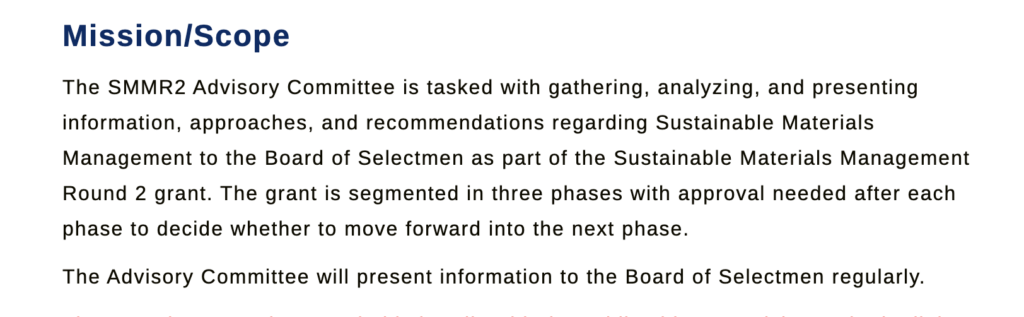
They define their mission as advisory, but provide very little explanation in plain language about the grant itself, its goals, or what recommendations the committee may be working toward.
About This Grant
See the actual grant program document
What Is This Grant Really About?
The Connecticut Department of Energy and Environmental Protection (DEEP) has created a grant program to help municipalities reduce the amount of waste sent to landfills and waste-to-energy facilities.
The State is concerned that disposal capacity is shrinking while hauling and disposal costs continue to increase.
To qualify for funding, municipalities must propose programs that permanently reduce the amount of trash requiring disposal. The programs must eventually become financially self-sustaining because grant funding is not intended to last forever.
Let’s forget about the confusion for a moment. Let me give you something more about Sustainable Materials Management (SMM).
What is SMM?
SMM looks to get the most value out of the things used or consumed while creating the least amount of waste and environmental impact.
The “management” of it looks at the entire life cycle of every product used:
- Where raw materials come from
- How products are manufactured
- How they are transported and used
- What happens when we’re finished with it (waste)
Instead of focusing only on throwing things away responsibly, SMM asks:
“Can we reduce what we use, reuse it longer, repair it, recycle it, or design it better in the first place?”
A Simple Analogy
Imagine your household budget.
You wouldn’t just worry about taking out the trash at the end of the month. You would also think about:
- Buying only what you need
- Fixing things instead of replacing them
- Reusing items whenever possible
- Getting the most value from your purchases
While Sustainable Materials Management technically examines the entire lifecycle of products, the Southbury discussion appears to be focused almost entirely on waste reduction and diversion at the transfer station. In other words, can we reduce the amount of trash we pay to send to landfills and incinerators?
There’s only a few ways to accomplish that.
- Recycle more
- Reduce food scraps
- Encourage reuse
- “Pay As You Throw” or Unit-Based Pricing (Residents pay according to the amount of trash they dispose of)
- Partner with neighboring towns (regional waste centers)
This is all coming from the CT Department of Energy and Environmental Protection (DEEP). DEEP is particularly focused on food scraps because they represent a significant portion of the waste stream and are often heavy due to moisture content, making them a major target for diversion efforts.
What you probably want to become familiar with is the word “diversion”. When they talk about diverting waste, they want a program that keeps certain waste (food) from landfills and incinerators. Think about that one for a second because where do you think it will go?
Southbury has already explored this topic through prior discussions and pilot concepts involving food scrap separation. If Southbury is going to be awarded any DEEP grant money, they must provide a way for the program to be financially self-sustaining because it was made clear that it would not be a permanent source of funding for a municipal program. A town’s waste program must pay for itself.
By all accounts, it appears the town is leaning heavy into food scrap diversion. That does not necessarily mean the town has committed to a food scrap program, only that much of the committee’s discussion and the grant’s priorities appear to point in that direction, especially considering there’s already been a trial to do this.
What Is “Pay As You Throw”?
One approach encouraged by DEEP is called Pay-As-You-Throw (PAYT), also known as Unit-Based Pricing (UBP).
Instead of everyone effectively paying the same amount for disposal through taxes or fees, residents pay based on the amount of trash they generate. The less trash generated, the less paid.
Some municipalities accomplish this through special town trash bags or different pricing based on container size.
But if it doesn’t go to a landfill or incinerator, where does it go?
This gets long and complicated. The short story is that it goes to private business where there are models for them to make profit from taking possession of our food waste.
If the town can sign contracts with these private companies to take our food waste and it costs less to dispose of it that way, the transfer station budget is reduced. I think that’s the ideal outcome.
Whether any part of this costs the taxpayer more money remains to be seen.
The Bottom Line
The real question is not whether food scraps can be diverted. They can.
The real question is whether diverting food scraps will cost Southbury taxpayers less, cost the same, or cost more than existing disposal methods.
If the program can permanently reduce disposal costs while remaining self-sustaining, taxpayers may benefit. If it requires ongoing subsidies or new fees, taxpayers should understand those costs before any program is expanded.
That is ultimately what the Board of Selectmen and residents should be evaluating as the committee brings forward recommendations.